
Our Global Voices Bookshop
- Greening the Global Economy: Green Economics: Reform and Transformation. Edited by Sofia Amaral (Portugal) ISBN 9781907543944

Written by a young Portugese economist, from NOVA School of Business and Economics, Portugal, Researching into Economics and International Management (CEMS-MIM). It pulls together ideas, issues, solutions and experiences from people all around the globe from all corners of the world to challenge the assumptions of mainsteam economics and finance. The book aims to introduce the reader to the vibrant kernel of change in economics to enable a better more benevolent, succecssful and efficient economy to arise from the ashes of the existing, chaotic and unequal one. Itvery easy to forget the interdependence between the economy and the environment. The ultimate truth is that there is no economy without the environment.
The book explores the relationship between economics and the environment and Miriam Kennet and Michelle Gale de Oliveira are co editors of this exciting book – the Greening of the Global Economy: Reform and Transformation. The author contributors are spread widely from young innovators to world-renowned experts of various fields,coming together to discuss the problems that currently affect the world and how green economics, given its holistic and multidisciplinary approach, can address those challenges.
Being an open-source forum of people from all around the world, all continents (except Antarctica) are represented, which contributes to the books diversify and enrich the debate. This discussion is a compilation of fresh and innovative ideas on the process of greening the global economy from the perspective of different disciplines and regions of the world. This book is a reflection of the Green Economics Institute’s global network, which was put together by Judith Felton, Miriam Kennet and Michelle Gale de Oliveira to drive change and spread the discipline of green economics throughout the world.
This network is rich in different perspectives of global affairs and regional issues, which has shed light on serious problems affecting the global economy. From the Eurozone crisis affecting my country, Portugal, and other European countries, to the rapid growth of the BRICS and the social uprisings in North Africa and the Middle-East, the economy is giving signs of weakness. As we argue in this book, green economics can reform and transform the economy system into one that promotes economic, social and environmental justice.
This book is therefore a practical handbook of ideas, issues, solutions and experiences from people all around the globe. For economists, students, policy makers and community campaigners as well as governments and ministers, this volume explores case studies from around the world to inspire other communities and countries to overcome their economic and social problems through the greening of their economy. We hope you enjoy the book and take part in the movement of greening the global economy! Sofia Amaral September 2013
RRP £40.00
2. Rebalancing the Economy Edited by Chris Brooke (Cambridge University) ISBN 9781907543845
Rebalancing the Economy ‘It’s the economy, stupid’ is one of the most well-known phrases in politics and it perfectly highlights the problem with politics today. However, you cannot blame the politicians that they prioritise the economy over everything else; the problem lies in how we measure their success. GDP is the most quoted statistic about any country’s economy with economic policies being judged mainly by their effect on GDP. Most other policies are heavily judged on their effect on this one statistic. Governments have risen and fallen on the back of this one statistic.
In 1934 Kuznets warned against equating GDP with well-being. However, for the last 70 years that is what it has become.Growth will always trump other objectives and so these politicians only want to measure growth. This has become even more relevant since the recession, when many governments have focused on growth. Governments are voted in on their short term agendas.
One fundamental truth must be recognized: the planet cannot accommodate high income status for all 7 billion plus of its inhabitants. For every country to attain per capita GDP of $13,000 (the World Bank’s definition of high income), global GDP would need to rise to $91 trillion. If, however, we already use the equivalent of 1.5 Earths to provide the resources we consume and to absorb our waste, how can we? The planet can sustainably support a GDP of around $50 trillion. If the planet already exceeds its sustainable carrying capacity, we need to be reducing our demands on it – not adding new ones. Simply put, we can no longer depend on GDP growth, and the limitless wealth accumulation that it implies, to solve our social and economic problems.
About the Authors: Superb and well known writers
Christopher Brook, (Cambridge University) Christopher Brook is an economist . His interests lie in sustainable development and poverty alleviation. He worked in Nicaragua on a sustainable watershed management project where he began to understand the needs and challenges that those in poverty face. He hopes to use this gained knowledge in the future to help relieve poverty sustainably all over the world. He worked for the Green Economics Institute and ran the 9th Annual Green Economics Institute Conference at Oxford University in July 2014 and is a deputy editor of the International Journal of Green Economics
Miriam Kennet, is a specialist in Green Economics. She is the Co-Founder and is CEO of the Green Economics Institute. She also founded and edits the first Green Economics academic journal in the world, The International Journal of Green Economics, and she has been credited with creating the academic discipline of Green Economics. Green Economics has been recently described by the Bank of England as one of the most vibrant and healthy areas of economics at the moment. Having researched at Oxford and South Bank Universities, she is a member of the Environmental Change Institute, Oxford University. She has been featured in the Harvard Economics Review and Wall Street Journal as a leader. Ban Ki Moon invited her to his Global Leaders Conference on Climate Change at the United Nations. Recently she was named one of 100 most powerful unseen global women by the Charity One World action for her global work and won the Honour Award from the Luxembourg Ministry.
Helene Albrecht holds a Bachelor in Music from Musikhochschule Koln, Germany and an LLP and LLM Specialist degree from Westminster University, London and University College London respectively. Following an intensive career as teacher and performing artist her recent research interest is dedicated to the current entanglement and progressive humanization of law and economy. Joyce Appleby is an American historian. She is Professor Emerita of History at University of California, Los Angeles (UCLA). She served as president of the Organization of American Historians (1991) and the American Historical Association (1997).
Joel Bakan, a professor of law at the University of British Columbia, wrote the awardwinning and widely-translated book and film (co-created with Mark Achbar) The Corporation, as well as, more recently, Childhood Under Siege. Highly regarded as a teacher, scholar, and social commentator, Bakan makes his home in Vancouver, Canada Christopher Brook is an economist at the University of Cambridge. His interests lie in sustainable development and poverty alleviation. He worked in Nicaragua on a sustainable watershed management project where he began to understand the needs and challenges that those in poverty face. He hopes to use this gained knowledge in the future to help relieve poverty sustainably all over the world. He currently works for the Green Economics Institute and ran the 9th Annual Green Economics Institute Conference at Oxford University in July 2014 and is a deputy editor of the International Journal of Green Economics
Professor Graciela Chichilnisky, (USA and Argentina) has worked extensively in the Kyoto Protocol process, creating and designing the carbon market that became international law in 2005. She also acted as a lead author of the Intergovernmental Panel on Climate Change, which received the 2007 Nobel Prize. A frequent keynote speaker, special adviser to several UN organisations and heads of state, her pioneering work uses innovative market mechanisms to reduce carbon emissions, conserve 14 Rebalancing the Economy biodiversity and ecosystem services and improve the lot of the poor. She is a Professor of Economics and Mathematical Statistics at Columbia University and the Sir Louis Matheson Distinguished Professor at Monash University.
Chuck Collins is a senior scholar at the Institute for Policy Studies (IPS). He co-edits the web resource, www.inequality.org, an online portal for analysis and commentary. He is author of the book, 99 to 1: How Wealth Inequality is Wrecking the World and What We Can Do About It (Berrett Koehler Publishing, 2012). Richard Cooper is a Maurits C. Boas Professor of International Economics at Harvard University. He has published widely and has served as chairman of the Federal Reserve Bank of Boston and as Under-Secretary of State for Economic Affairs in the US State Department Dr Craig Duckworth is head of the department of Economics and International Business, and principal lecturer in Economics and Business Environment at Anglia Ruskin University. His research interests lie at the interface of economics and ethics.
Aart Heesterman has a degree in political and social sciences of the University of Amsterdam. After four years as a civil servant in The Hague he moved to the University of Birmingham, UK. He has published a number of books related to economic forecasting ands planning. In retirement he started what eventually became a joint publication with his wife Wiebina: the more environmentally orientated book Rediscovering Sustainability. Wiebina Heesterman is also Dutch by nationality, living in the UK since the mid 1960s. She has a PhD in Law on children’s rights from Warwick University as well as degrees in information science and IT. She read extensively on biodiversity and climate change while writing Rediscovering Sustainability jointly with A. R.G. Heesterman, then wrote a chapter on climate change denial for a book aimed at engineers and followed a climate change course.
Hazel Henderson, D.Sc.Hon., FRSA, president of Ethical Markets Media (USA and Brazil), is a futurist, evolutionary economist, author of award-winning Ethical Markets: 15 Rebalancing the Economy Growing the Green Economy and many other books. She has advised the U.S. Office of Technology Assessment, the National Academy of Engineering and the National Science Foundation. She founded the EthicMark(R) Awards for Advertising, created the Green Transition Scoreboard(R) and the Principles of Ethical Biomimicry Finance(R), and co-developed with Calvert the Ethical Markets Quality of Life Indicators. In 2012, she received the Award for Outstanding Contribution to ESG & Investing at TBLI Europe; was inducted into the International Society of Sustainability Professionals Hall of Fame in 2013, and in 2014 was again honored as a “Top 100 Thought Leader in Trustworthy Business Behavior” by Trust Across America.
Manan Jain, An economist from India, specialising in the Gift Economy. Manan addressed the Green Economics Institute’s Conference at Oxford University in 2012 (India)
Miriam Kennet, is a specialist in Green Economics, she is the Co-Founder and is CEO of the Green Economics Institute. She also founded and edits the first Green Economics academic journal in the world, the International Journal of Green Economics, and she has been credited with creating the academic discipline of Green Economics. Green Economics has been recently described by the Bank of England as one of the most vibrant and healthy areas of economics at the moment. Having researched at Oxford University, Oxford Brookes and South Bank University, she is a member of the Environmental Change Institute, Oxford University. She has taught, lectured and spoken at Universities and events all over Europe, from Alicante to Oxford and Bolzano, and to government officials from Montenegro and Kosovo to The UK Cabinet Office, Transport Department, National Government School and Treasury and spoken in Parliaments from Scotland to Austria and The French Senat and Estonia. She is also a regular and frequently speaks at public events of all kinds, and after dinner speaker. She has a delegation to the UNFCC COP Kyoto Climate Change Conferences and headed up a delegation to RIO + 20 Earth Summit: Greening the Economy in RIO Brazil. She regularly speaks on TV around Europe, most recently in Belgium, and Estonia and this year the BBC has made a special programme about her life and work. She runs regular conferences at Oxford University about Green Economics Publishing regularly and having over 100 articles, Chapters and other publications. She has been featured in the Harvard Economics Review and Wall Street Journal as a leader. 16 Rebalancing the Economy Recently she was named one of 100 most powerful unseen global women by the Charity One World action for her global work and won the Honour Award from the Luxembourg Ministry for her work.
Martin Koehring is a senior editor in the Content Solutions team of the Economist Intelligence Unit (EIU), where he works on bespoke research programmes with a focus on sustainability and healthcare. Previously he was Europe editor in the EIU’s Country Analysis team. Prior to joining the EIU, Martin worked as a senior Economist at business intelligence provider D&B. He studies International Politics in Wales, European Studies in Belgium and Economics in London Professor Dr Maria Alejandra Madi, holds a PhD in Economics. She works at the intersection between macroeconomics, finance and socio-economic development. Retired Professor at the State University of Campinas, Brazil, she is currently Director of the Ordem dos Economistas do Brasil and Counselor at the Conselho Regional de Economia – SP. Besides her participation as co-author in chapter books edited by the Global Labor University, she is a regular author with the Green Economics Institute.
Alastair McIntosh is an independent scholar, poet and broadcaster who holds or has held honorary fellowship or professorial positions at the universities of Ulster, Strathclyde, Glasgow and Edinburgh, as well as the Centre for Human Ecology. Best know for his books Soil and Soul, Hell and High Water and Rekindling Community, his writing has been described as “world changing” by George Monbiot, “life changing” by the Bishop of Liverpool and “truly mental” by Thom Yorke of Radiohead.
Kari Marie Norgaard is Associate Professor of Sociology and Environmental Studies at University of Oregon. Her research on tribal environmental justice and gender and risk and climate denial has been published in Sociological Forum, Gender and Society, Sociological Inquiry, Organization and Environment, Rural Sociology, Race, Gender & Class, and other journals, as well as by the World Bank. Her research has also been featured in The Washington Post, National Geographic, High Country News, and on National Public Radio’s “All Things Considered.” Her first book “Living in Denial: Climate Change, Emotions and Everyday Life” was published by MIT Press in 2011. 17 Rebalancing the Economy Norgaard is recipient of the Pacific Sociological Association’s Distinguished Practice Award for 2005.
Vandana Shiva is world-renowned environmental leader and recipient of the 1993 Alternative Nobel Peace Prize (the Right Livelihood Award), Shiva has authored several bestselling books, most recently Earth Democracy. Activist and scientist, Shiva leads, with Ralph Nader and Jeremy Rifkin, the International Forum on Globalization. Before becoming an activist, Shiva was one of India’s leading physicists.
Rosamund Stock is completing a PhD in the social psychology of distributive justice. She has worked within NGOs developing ideas about the nature of social relationships and recasting the economic narrative. She has worked for the ILO on their Socioeconomic security survey providing the social psychological underpinning for the project. She has also advised research teams on the relevant social psychology for their project as well as publishing in the International Journal of Green Economics.
Joss Tantram is a founding partner at Terrafiniti LLP, a pioneering sustainability and systems consultancy. He has 20 years private and not for profit experience in the UK, Europe and world-wide. He leads Terrafiniti’s strategic services and their R&D and innovation initiative, Towards 9 Billion.
Sir Crispin Tickell is a former British Diplomat who worked for several organisations including President of the Royal Geographic Society, Warden of Green College Oxford, Chancellor of the University of Kent and is currently director of the Policy Foresight Programme. John Weeks is Professor Emeritus of the University of London, School of Oriental & African Studies. He is author of over 100 scholarly publications including 12 sole authored books. He has consulted for many international organizations and advised numerous governments on economic policy
RRP £70.00 to libraries £35.00 to individual readers
Asia
1 The Greening of Asia and China ISBN 9781907543234 (Edited by Miriam Kennet and Norferyanti Kammarudin)

This booko ffers perspectives from people all over the world, from a variety of backgrounds. It is well suited for students, campaigners, policy makers, & anyone with an interest in Asian countries and green economics. The Green Economics Institute is very active in spreading Green Economics around Asia and China at all levels and in all walks of life and our work is creating a great deal of interest. This experience has allowed us to bring together the voices from many different green initiatives into a single volume for the first time.
This book has been compiled by the global leaders in the field, including a number of high profile specialists.
Book Overview: 8 parts. No. of pages 350 approx.
Part 1: Introduction: Dynamic, technological innovation and the greening of Asia and China: The social and environmental wealth paradox
Part 2: The Greening of Asian and Chinese Business, Green IT and Green Technology and Trade
Part 3: Gender as a core component of Green Economics in Asia
Part 4: The Green Built Environment
Part 5: Climate Change and Energy
Part 6: Social Justice
Part 7: Biodiversities and Species Extinction
Part 8: Sustainable Development
Green Economics In Asia Asia and China form the powerhouse of the world economy of the 21st century, with much of the area enjoying more than 5% GDP growth. Other parts of the region are still struggling with deep and life-threatening poverty and inequality. Other people are challenging stereotypes and norms. One woman is running a Real Estate Company in Saudi Arabia, one man has built an entire city on solar and renewables. Several mayors in Hong Kong and Indonesia are leading with Green Tech, sustainable city initiatives. Japan has had its own transformation and green awakening moment with the terrible, natural and man-made events in 2011 and Japan is experiencing its highest debt ratio ever and so the region is not immune to the global debt crisis.
The book explores the paradoxes of the successes and challenges of two of the main BRICS, India and China. It also considers aspects of the development of the economy of the CIVETS in Asia: Indonesia, Vietnam and Turkey, which are also leading the world in change and development. The book presents Asia’s ground breaking innovation and green tech revolution, which have successfully challenged the world’s economic, political and institutional frameworks in this truly global world.
The book asks what global sustainability looks like in a world where each of us is dependent and inter-dependent on the whole human family, nature, other species, the planet and its systems? We have much to learn from each other. This book is the first to try to chart the innovations and challenges that the Asian and Chinese economic miracles are bringing from a green perspective, and to hear from voices all around the region about the implementation of the green economy. This book sets the scene for the physical and social environment of the 21st century, and introduces the context and features of these changes to the reader.
It also begins the discussion of the New World Order and also provides suggestions for world government and world governance to meet the challenge of global environmental and social change and the issues that this raises. Sha Zukang, the leader of the Rio +20 conference, passionately believes in sustainable development and the greening of the world economy. Welcome to the “Age of Global transformation and the Age of Green Economics” Ban Ki-Moon Head of the United Nations
Biographies of Editors:
Miriam Kennet is CEO, director and co-founder of the Green Economics Institute and the founder and editor of the International Journal of Green Economics. She is a member of Mansfield College, Oxford University and the Environmental Change Institute, Oxford University. She is a UK government recommendation for the IPCC and has her own delegation to the Kyoto Climate Protocol Conferences and to the RIO +20 Conference. Her research at South Bank University, London and at Templeton College, Oxford University focused on green issues and strategic management. She is editor and author of 100s of articles, book chapters and books in many languages. Miriam recently was named as one of the 100 most powerful unseen women making change globally at a ceremony in London. She is the founder and Director of The Green Economics Institute and the International Journal of Green Economics and is credited with the development of the inclusive, academic discipline of green economics.
Norfaryanti Kamaruddin is currently a Research Officer at Techno Economics and Policy Laboratory, Institute of Tropical Forestry and Forest Products, Universiti Putra Malaysia (UPM). Qualified in Agribusiness, she accumulated more than 5 years research experience with UPM. She researches and writes in the field of green economics.
Other Contributors to the book: Miriam Kennet (UK),Norfayanti Kamaruddin (Malaysia), Ryota Koike ( Japan), Michelle S. Gale de Oliveira (Brazil and USA), Dr.Lu Wei (China), Marina Mangoni (Italy), Richard Sanders (China), Dr.Hans-Guenter Wagner (China and Germany), Dr. Natalie West Kharkongor (India), Shuhan Liu (China), Yujing Wang (China), Wei Ren(China and UK), Winston Ka-Ming Mak (Hong Kong), Bengi Yanik-Ilhan (Asia), Nursel Aydiner-Avsar (Asia), Seldag Ceylan(Turkey), Jigme Tashi Tsering(Bhuttan), Maria Delfina Rossi(Spain and Greece), Hayal Ayca Simsek (Turkey), Nevzat Simsek, Davide Bottos (Italy), Kristina Jociute (Lithuania), Katherine Kennet (UK), Soma Dey (Bangladesh), M.R.Sheriza(Asia), M.D.Zaidi(Asia),Zaiton Samdin(Asia), Juliane Goke (Germany and Indonesia), Professor Peter Yang (USA), Indira Dutta (India), Professor Immai (UK)
The Greening of India: The Economic Miracle
2 The Greening of India ISBN 9781907543 (Edited byProfessors Natalie West and Indira Dutta, India)
This book was launched at the special Green Economics Conference on 7th and 8th August 2014 at the Shillong Business School, India, by Professor Natalie West Kharjongar, and created by the Green Economics Institute in the UK. It also edited by Dr Indira Dutta of the Central University of Gujarat and her team and supported by Professor Graciela Chichilnisky.
The book is from a group of writers, thinkers, policy makers and innovators all coming together to make beneficial change and to take the economy into the 21st Century. It seeks to inform the next steps towards a more inclusive and sustainable economy. The book informs concerned groups, individuals, state actors, governments and young peoples; organisations, about green innovations in one of the world’s most important economies. The book explores some of its unique explanations and its costs, strengths and weaknesses as well as introducing exciting examples of changing perspectives and ground breaking initiatives and how they are being applied in India. The book also covers India’s status as a BRIC and an important emerging economy at the forefont of the global advances in economics and finance, as well as its need to ensure all its citizens share in the contemporary economics miracle of India, as a 21st century economic power.
Book Overview: 7 parts. No. of pages 400 approx. ISBN: 9781907543500
Part 1: Introduction – Setting the Scene
Part 2: Economics and Finance in India
Part 3: Business
Part 4: Nature, Environmental Change & Justice
Part 5: Renewable Energy
Part 6: Social Justice
Part 7: Green Economics: Aims and Features
With a population of 1.252 billion people India currently has the second largest population globally and is projected to overtake China in the middle of this century. It is the 10th largest economy with a nominal GDP of $1.877 trillion and 3rd largest economy, when measured using PPP. India’s development will have large repercussions for the entire world, economically, socially and environmentally.
Green Economics has become very relevant as a means of providing the solutions to some of the challenges of India today. The global social, economic and environmental crisis in all its forms is starting to really impact the life of its citizens but also its economy in various subtle and not so subtle ways. Conflicts and stresses are errupting as a result of the pressure for resources. New efforts are being made, the world over, to try to become self sufficient in energy, and many are moving to renewables, decarbonising and generally trying to limit pollution and create a Green Economy as a way of staying in the global economy or maintaining their own regional or local economy. An economy seemingly unendingly diverted from its aim of provisioning for everyone and generally keeping healthy, beneficial for all and uncorrupted. Green Economics has things to say in all these areas and is being used as one of the beacons of hope around the world and in almost every economy to a greater or lesser extent.
Let us all work together to make changes and to help direct India onto a sustainable development path that will lead to inclusive growth to bring millions out of poverty without damaging the environment for future generations of Indians.
3 The Greening of Indonesia ISBN 9781907543821 (Edited by Dr Dessy Irawatti and Stephan Ongo, Indonesia)
Unique book charting the change to Green Economics and Green Economy in Indonesia and the opportunities it presents. Supported by the Bank of Indonesia and the Indonesian Scholars Association. It was launched by the Indonesian Ambassador and the Educational Attache at a conference at Oxford University.
Europe
1 The Greening of the Mediterranean ISBN 9781907543906 Edited by Dr Enrico Tezza,( Italy) and Dr Michael Briguglio,(Malta) and Professor Doaa Salman ( Egypt)

The Greening of the Mediteranean is a unique book which will explore current developments for change towards green ideas, government, policy, campaigning and intellectual trends from writers all around the Mediteranean sea, and also discusses historical environmental and social influences which may have led to historic and prehistoric changes, such floods,volcanoes, tsunamis and natural events and social events such as empire, and the decline or sudden collapse for example of Atlantis and the Minoan civilisations, how we can contribute to the development and success in a green way of the Mediteranean area and Europe both now and in the future.”To combat much of the current misery experienced by many people around the Mediterranean today as a result of the crisis, as the Mediterranean peoples have suffered more than most, we celebrate the potential of the area, and critique the current, prevailing approaches to Economic and Environmental issues, which are focused on managerialist perspectives of the so called “green growth” or “green capitalism,” rather our own original and novel perspective which emphasizes conventional growth as the problem. We promote progressive thinking towards ecology and social justice. Pollution and resources depletion are explained as part of a much bigger emerging picture than simply mitigation or adaptation principles. We can no longer afford to simply maintain the outdated, unchanged, mainstream socio and economic models. So, we introduce alternatives for economic and societal organisation which support a more sustainable and balanced relationship with nature and we stress combating poverty as core to this achievement.” – Miriam Kennet and Dr Enrico Tezza (Italy)
2 The Greening of Italy ISBN 9781907543920 Edited by Edited by Alberto Truccolo, Dr Enrico Tezza, (Italy)
Michael Briguglio lectures at the Department of Sociology of the University of Malta. His main interests are environment, social movements, social policy and politics with particular emphasis on NGOs and their role in society. He is also very active in Malta’s environmental movement and has been the leader of the Greens in Malta. He has written regularly in our Green Economics academic journal over many years.
Michelle S. Gale de Oliveira is a director of the Green Economics Institute, UK. She is a member of the Law School of the University of London School of Oriental and African Studies (SOAS), holding an MA in Human Rights Law with a focus on Islamic Law, Peace-Building, and Developing Countries. Founder of the Gender Progress Consortium, she holds degrees in Political Science and International Relations from Richmond, the American International University in London (RAIUL), and is currently deputy editor of the International Journal of Green Economics. Her writing has been featured in Europe’s World, one of the foremost European policy magazines. She lectures and speaks on Human Rights, Environmental and Social Justice, Gender Equity, International Development and Green Economics internationally. Recently she ran a conference on women’s unequal pay and poverty in Reading, UK, lectured at the Oxford University Club on the human rights of land reform, lectured on green economics in Berlin, at retreats in Glastonbury, UK, and is a regular speaker at international conferences. She has appeared in the media in Africa, Europe, and Latin America. Michelle is a member of the Human Rights Lawyers Association, the Law Society of England and Wales Human Rights Lawyers Group, the London Middle East Institute. In 2010/2011, she was a delegate to Conference of Parties (COP15/16) in Copenhagen and Cancun, and in 2012 led a delegation to RIO+20, where she ran three side events on green economics.
Nicola Gallinaro is currently director of LAG (Local Action Group – is a body funded by the European Union to promote rural development and cooperation between territories) in the area of Garda Lake in Northern Italy. He graduated in Forest Science by University of Padua in 1991 with honors. After degree he had post graduation experiences at Wageningen Agricultural University (NL). From 1995 he is working as free consultant in environmental and landscape planning and management. During his career Gallinaro continue to research in alpine fora, wooden fres and environmental analysis using GIS. He is author of different scientifc publications in the feld of forest ecology and rural development.
Francesca Goff is currently project manager of the Green Line Cooperation Project at LAG (Local Action Group) GardaValsabbia in Northern Italy. She graduated in Political Sciences by University of Padua in 2002 with honors. After degree she attended a master’s degree at University of Bologna in the feld of Health Law and Social Services. Freelance journalist, from 2003 she is communication consultant working for nonproft organizations and communication agencies.
Miriam Kennet is a specialist in Green Economics, she is the Co-Founder and is CEO of the Green Economics Institute. She also founded and edits the frst Green Economics academic journal in the world, the International Journal of Green Economics, and she has been credited with creating the academic discipline of Green Economics. Green Economics has been recently described by the Bank of England as one of the most vibrant and healthy areas of economics at the moment. She is on the Assembly of the Green European Foundation and also on the steering group of the European Network of Political Foundations. She has co authored many books about the Greening of Europe, the Mediterranean. Her work has been published in Italian in the Trecanni and she has taught in Italy and lectured at Bolzano University and Venice International University and elsewhere. She was taught economics by Professor Gracia Ietto Gilies, who is originally from Italy and who is a very well known economist who specialises in the effects of Multi national Corporations on the Economy. Miriam acredits many of her perspectives and ideas to the outstanding teaching she received from Professor Ietto Gilies. The Greening of Italy: Crisis and Recovery 17 Miriam was given the prestigious Honour Award at the Luxembourg Business Summit,in front of 500 people by the Luxembourg Minister of Trade and Industry. She was also named alumni of the month by South Bank University in London and also was named as one of 100 most powerful women globally by the Charity One World Action. Having researched at Oxford University, Oxford Brookes and South Bank University, she is a member of Mansfeld College, Oxford University and the Environmental Change Institute. She has taught, lectured and spoken at Universities and events all over Europe, from Alicante to Oxford, and to government offcials from Montenegro and Kosovo to The UK Cabinet Offce, Transport Department, National Government School and Treasury and spoken in Parliaments from Scotland to Austria and The French Senat and Estonia. She is also a regular and frequently speaks at public events of all kinds, and after dinner speaker, advising in the Uk Parliament and the Bank of England and in Brussels on the Eurozone crisis, the high speed rail and the general economics situation. She is also very active in spreading Green Economics in Asia, China, and all round Africa where people fnd it may be one of the beacons of hope at the moment in an age of Austerity and Cuts as it provides a completely new way of looking at the world. Her work is very practical and she worked in factories and engineering for many years in the past. She has a delegation to the UNFCC COP Kyoto Climate Change Conferences and headed up a delegation to RIO + 20 Earth Summit: Greening the Economy in RIO Brazil. She regularly speaks on TV around Europe, most recently in Belgium, and Estonia and the BBC has made a special programme about her life and work. She runs regular conferences at Oxford University about Green Economics and this year has run 8 events from Youth in Action for Young People from Egypt involved in the revolution, People from FYRO Macedonia, Italy and other countries, as well as the Green Built Environment, The Greening of China as the Chinese government is very interested in her work, Womens Unequal Pay and poverty, Green Economics and Methodology, truth, fact and reality with critical realism and several other events. Publishing regularly and having over 100 articles, papers and other publications, including Green Economics:Voices of Africa, The Green Economics Reader, Handbook of Green Economics: A Practitioners Guide, The Green Built Environment, Women’s Unequal Pay and Poverty, Green Economics and Climate Change, as well as a new chapter on the green built environment and climate change for Wileys publishers in Lamond, Hammond and Proverbs. She also publishes in scientifc papers, including the Latvian National Scientifc Papers and Journals for example. She has been featured in the Harvard Economics Review and Wall Street Journal as a leader.
Professor Dr Maria Alejandra Madi, holds a PhD in Economics. She works at the intersection between macroeconomics, fnance and socio-economic development. Retired Professor at the State University of Campinas, Brazil, she is currently Director of the Ordem dos Economistas do Brasil and Counselor at the Conselho Regional de Economia – SP. Besides her participation as co-author in chapter books edited by the Global Labor University, she is a regular author with the Green Economics Institute. The Greening of Italy: Crisis and Recovery 18 Wilhelm Schmid is an economist from Austria, who worked at the Green Economics Institute recently and edited our academic journal and our The Greening of the Mediterranean Book as well as writing for many of our policy papers. He work is focused on the feld of economics or politics, focusing on the possibilities to improve peoples life, considering their well- being as the goal of economic activities. He is an Economist from the University of Vienna and his special interests are: – “The evolution of top incomes in the United States from 1980 until 2007 – why are the rich always getting richer?”and “Energy security in the European Union – Can you supply what we demand?
Dr Enrico Tezza is a senior training specialist and has a background in social research and evaluation studies. After a career in the Italian Ministry of Labour and local public institutions, he joined the International Labour Organisation in Turin in 1992. He is labour market advisor for the Green Economics Institute. Subjects covered vary from training policy to employment and active labour market measures. His current focus interest is on social dialogue for green The Greening of Italy: Crisis and Recovery 19 jobs. His main publication was Evaluating Social Programmes: the relevance of relationships, and his latest publications include Dialogue for Responsible Restructuring and Green Labour Market for Transitions. Alberto Truccolo is a young entrepreneur who operates in the feld of social responsible and environmentally friendly investments. He aims to bring green economics claims into practice through politics, in fact he is a member of the “Youth European Parliament”. He manages a blog raising awareness about themes such as recycling and climate change, as well as poverty and inequality; also, he runs conferences in his institute and in his city discussing issues such as the phenomenon of automation and its consequences on the socio-economic paradigm, the potential of renewable energies and the ineffciency of the current neo-liberalism. Currently, he works for the Green Economics Institute, on the Editorial Team of the double blind peer reviewed academic, International Journal of Green Economics, and in July 2014 he was on the management team of the 9th Annual Green Economics Institute, Green Economics Conference at Oxford University. He is the editor of this current book and lead writer of many of the chapters.
Dr Jeffrey Turk PHD has a doctorate in particle physics from Yale University and after working as a physicist at the European Laboratory for Particle Physics (CERN) gaining an MA in transition economics at the Central European University in Budapest and then a DPhil in contemporary European Studies from the University of Sussex. He is a research fellow at the Scientifc Research Centre of the Slovenian Academy of Sciences and Arts, where he researches realist biography and European Policy. He ran a research conference at the University of Leuwen on critical realist narrative biographical methods and this events fndings have now been published as a book. He has produced many articles on Green Economics and methodological innovation for our academic journal and books
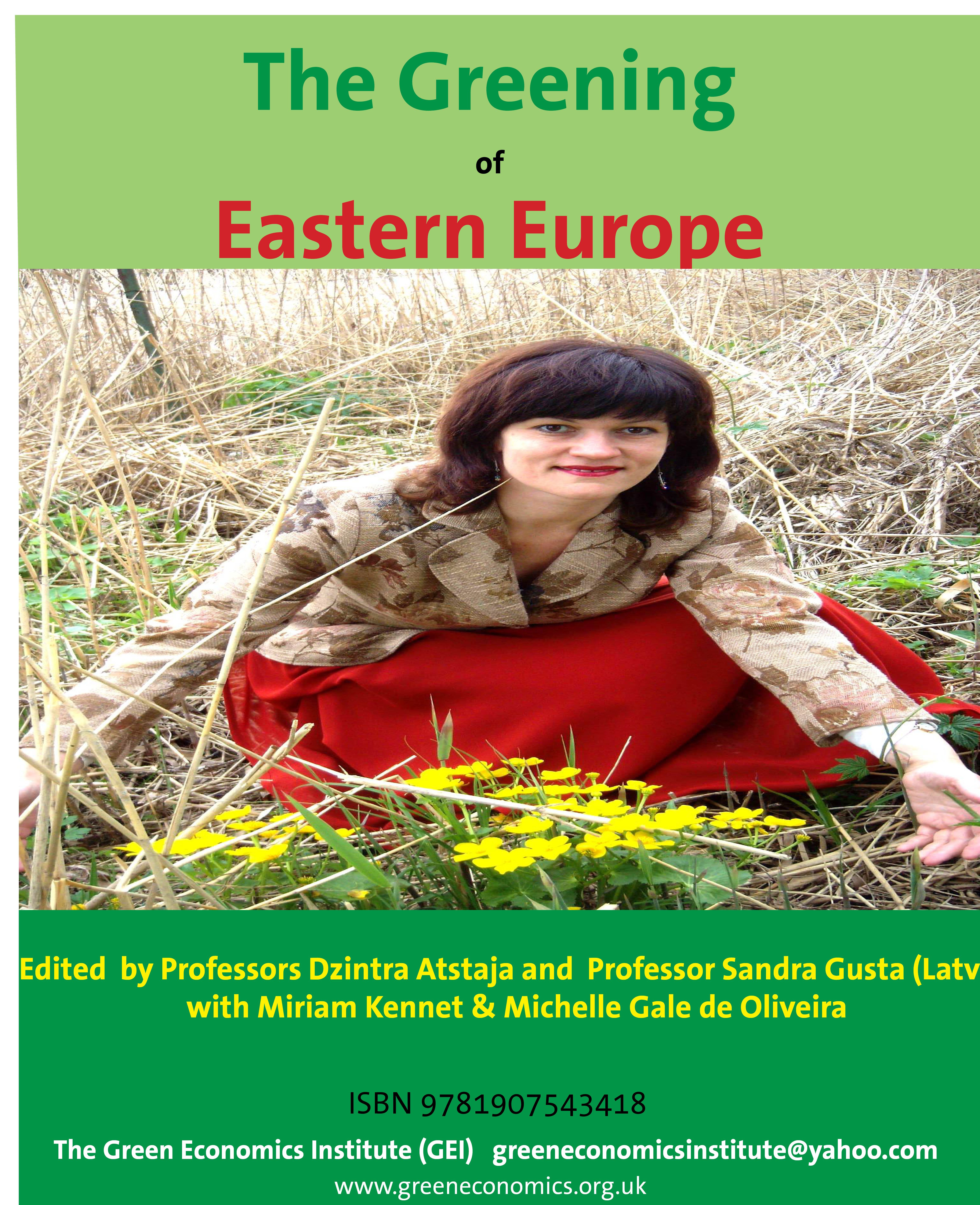
3 The Greening of Eastern Europe ISBN 9781907543418 Edited by Professor Sandra Gusta (Latvia)
Editors Biographies
Michelle S. Gale de Oliveira, author and Director of the Green Economics Institute, specialist
in development and human rights law. Founder of the Gender Progress Consortium.
Dr Sandra Gusta is an Associate Professor, Doctor of Social Sciences in Economy in Latvian
University of Agriculture, Department Architecture and Building (Latvia), a member of the Board
of LEA (Latvian Association of Economics), and a Member of the Latvian Association of Civil
Engineers, Education and Science section.
Professor Dzintra Atstaja is a Doctor of Economic science and Associate Professor of the BA School of Business and Finance (Latvia) and head of Technogenic environmental safety research laboratory and senior researcher at Riga Technical University. She specializes in macroeconomics and sustainable development, environmental management, civil defense and work safety. She is a member of the European Society for the History of Economic Thought and the Latvian Association of Economics.
Miriam Kennet, author and Co- Founder and Director of the Green Economics Institute and trained at Oxford University’s Environmental Change Institute and was named as one of 100 Powerful Women globally who make change happen. She has taught and travelled extensively in Eastern Europe, having appeared on TV in several countries and taught and spoken in Montenegro, Estonia, Poland, Germany, via skype in Turkey and FYRO Macedonia and her work has been published in a number of European languages including Latvian. She has travelled overland by train, boat and coach to Estonia, Hungary, Albania, Latvia, Poland, Lithuania, Serbia and Slovenia
4 Eastern Europe: Green Economics Policy and Practise
ISBN 9781907543890 Edited by Odeta Grabauskaite (Lithuania) and Professor Dzintra Atstaja (Latvia)

The Green Economics Institute has been very active in Eastern Europe asGreen Economics is beginning to be regarded as a very useful tool in helpingto address some of the contemporary problems of the area. It can guide policymaking in terms of self sufficiency and in terms of a slow switch towardssustainability and decarbonisation. It is also informative on human rights,inclusion and access. The Green Economics Institute has been working in orwith partners in Montenegro, Latvia, Estonia, Lithuania, Romania, Moldova,Hungary, Kosovo, Bosnia, Serbia, Slovenia and Albania and many more, withUniversities and policy makers and government officials from across theregion. Many of our team members are from Eastern Europe and so it isextremely relevant to our work.
We also have thought for a long time that thisis a critical area in terms of the future of Europe’s Economy. Other membersof the team travel there regularly using the train overland from WesternEurope.
This is our second book about Eastern Europe and it is largelyinspired by the wonderful team members from Eastern Europe and thetraining courses we have run for government officials we have advised. We have also have been kindly invited to speak on the TV and radio in countries such asEstonia and some of our team members have been Members of theParliaments in the area. We ran a conference, at Trinity College, University of Oxford last year and this will be our second book resulting from the vibrant discussions there. With the new threats from invasion and geo politicalinstability and dependence for energy on larger neighbouring powers, as wellas the tension surrounding the Transatlantic Trade Treaty, there has neverbeen a more pressing need to get a Green Economy up and runningsuccessfully.
The Green Economics Institute has succeeded in creating and establishing adiscipline or school of Economics called “Green Economics” and seeks to reformmainstream economics itself into a well-defined goals-based discipline whichprovides practical answers to existing and future problems by incorporating allrelevant aspects, knowledge and complex interactions into a truly holisticunderstanding of the relevant issues. It uses complexity, holism, pluralism andinterdisciplinary working in order to widen the scope of economics, adding thescience from the green aspects, and the social ideas from economics discourses. Thisnew scope for the first time avoids partial explanations or solutions and also biasedand partial perspectives of power elites.
The Institute has begun to influence the methodology of mainstream economics,according to Professor Tony Lawson of Cambridge University’s EconomicsDepartment (2007). It uses trans-disciplinary and interdisciplinary methods so thatit can factor in the complexity of nature into economics. It seeks to provide all peopleeverywhere, non human species, the planet and earth systems with a decent level ofwell-being based on practical and theoretical approaches targeting both methodologyand knowledge and based a comprehensive reform of the current economicmainstream. It can, for example, comfortably incorporate glacial issues, climatechange and volcanic, seismic and earth sciences into its explanations and thus in this,and many other ways, it is far more complete and reflects reality much more closelythan its predecessors on which it builds. The current narrow conventional economicapproach using purposely designed methods, is challenged to bring areas andconcepts into its scope which have been until now neglected. Existing outdated orinappropriate propositions and solutions are examined and revised to provide arealistic and more comprehensive understanding of the subject.The Green Economics Institute argues for economic development based on economicaccess and decision making for all, including respect for cultural diversity andnormative freedom. It does this by bringing together all the interested parties, whowant to help in developing this progressive discipline, by inviting them to its events,and conferences and by means of such activities as writing books and publicationsand using its research, its campaigns and its lobbying and its speeches and lecturingall over the world.
The Green Economics Institute created the first green academic journalInternational Journal of Green Economics with publishers Inderscience.The Green Economics Institute has its own delegation to the Kyoto Protocol, and is arecommended UK government reviewer on the Intergovernmental Panel on ClimateChange (IPCC). Members of the Green Economics Institute have lectured or workedin governments and Universities around the world, for example Surrey University,the Schumacher College, The University of Bolzano, the Tyrollean Cabinet, via Skypein Thessaloniki, FYRO Macedonia, Turkey, the National Government School in theUK with top Cabinet Officials, at University in Cambridge and Oxford, TransitionTowns, Oslo, Norway, Liverpool University, Lancaster University, Abuja, Nigeria andGondar, Ethiopia and attended conferences in many places including Cancun, Mexicoand Riga, Latvia and appeared on TV and radio in Italy and Tallin in Estonia and theUK and Bangladesh amongst many others and received invitations the President ofRussia and from the governments and several universities in China and from severalgovernments and Princes in several Gulf States as well as several parts of the UnitedNations and the International Labour Organisation!Our ideas has been spreading into Eastern Europe and around it and hence TheGreen Economics Institute is pleased that a broader group of readers, students, policymakers, academics and campaigners are now aware of the possibilities of this newdiscipline. Therefore we are pleased to present this new volume which builds on thefirst one and extends the suggestions and goes into more detail about some emergingpractices. We hope you you will enjoy them as much as we have in putting it together
5 The European Economy: Crisis and Recovery ISBN 9781907543319 Edited by Miriam Kennet, Dr Enrico Tezza,( Italy) and Dr Michael Briguglio,(Malta)

A very topical book explaining the latest issues about Europe and the pressures on its economy and the solutions being sought. It explains how green solutions can offer hope in a very difficult contemporary picture.
Special offer- RRP £40.00 -plus postage during this crisis phase- £25.00 plus postage.
£15.00 each plus postage if you buy 2 or 3 copies.
Africa
1 Green Economics: Voices of Africa ISBN 9781907543098
Edited by Mhalet Mekonen, (Ethiopia) Miriam Kennet, Judith Felton and Amanna Winchester

This book is the first in a unique collection of voices from around Africa which addresses the green economics ideas which are emerging to solve some of the world’s most pressing problems. Indeed people from all over Africa are coming to the Green Ecnomics Institute in search of viable and better solutions than the main stream can offer them. This is the first in a series of books documenting ideas and challenges and the newest contemporary thinking of the people of Africa and hearing their voices speak themselves.
We do not edit or interfere with what is said in order to hear authentic suggestions and appeals for change as well as learning from their experience. This book is a two way dialogue and as such is fairly unique and began a whole genre of new types of books in which for the first time global voices can be heard loud and clear and with confidence.
Green Economics is concerned with establishing definitions of an overall well- being and happiness for all people everywhere and the planet and earth systems, rather than deriving simplistic quantitative statistics. The purpose of economics is redefined, positive and normative statements are clearly differentiated and a distinction is made between destruction on the one hand, calculated and hidden as economic “growth” and true growth and abundance of natural resources for people and nature on the other hand. Green Economics is reworking the philosophy behind economic theory, adding more recent philosophical discourses and ideas of “difference”. It builds on its enlightenment roots, adding feminism, postmodernism, and ideas about institutions and scientific investigations. It adds back the social and ethical element to decision making, while acknowledging the pivotal role of women and nature in real wealth creation. Green Economics opposes the simplistic undifferentiated growth imperative and many of the uncritical technical and social methods of economic propositions currently dominating economics but which are implicated in Global Environmental Change (GEC) and poverty. History, time, social and environmental justice are all incorporated back into the discourse to develop a truly “real” social and natural science, together with new learning from environmental science and philosophy. The Institute critically discusses Green Economics alternatives.
The Green Economics discipline is in the process of being shaped and is undergoing rapid development. Green Economics builds on insights from environmental and ecological economics, feminist theory, welfare economics, development economics, post structuralism and post Keynesian ideas, but moves beyond them to create a discipline that seeks to nurture new alternatives based on inter-generational equity and social and environmental justice. It is a discipline which replaces stewardship, dominion and dominance over other people, nature, the planet and its processes, with an economics philosophy which shows concern for and co-operation with each other and acknowledges its embededness within nature. It also seeks to provide actual benefit for other people, non human species, the earth systems, and planetary processes rather than using them simply as disposable supplies or resources for the economy. Key ideas include provisioning for all people everywhere, other species, nature, the planet and its systems, and always considering that everyone and everything on the planet has economics needs, impacts and responsibilities. All decision making and activities are based on the complex mesh of social and environmental justice.
Green Economics is the economics of doing and the economics of sharing with everyone and everything on the planet. Humans can’t survive on their own – we need each other and we need other species. A Green Economics perspective no longer uses other things on the planet as throw away inputs or resources to the economy but as beneficiaries of the economics of sharing and of economics transactions. This is a unique and innovative stance in economics! This book is the first volume to bring these core ideas to the general reader and to provide an insight into its development, theory and features.
About the authors
Priscilla Alderson is Professor of Childhood Studies, Institute of Education, University of London. Her sociology research includes work on children’s rights, competence and consent, the views and experiences of children with long-term illness or disability and services for them, ethics and methods of social research. She teaches on an MA about the sociology of childhood and children’s rights. Details of 300 publications are on www.ioe.ac.uk/ssru.
Rosita Bujokaite is at Vytautas Magnus University in Kaunas, Lithuania. She specialises macroeconomic analysis and economic politics. Her main topics of interest are related to economic crisis phenomenon and crisis management as well as the economic anti-crisis politics. She is participating in the activity of Lithuanian NGO Kaunas Club “The Economists” and is a member of Lithuanian economic association (LEA). She is a member and economics advisor to the Green Economics Institute.
Dr Susan Canney is a lecturer at Oxford University and a researcher of elephants and biodiversity in Mahli.
Graciela Chichilnisky created the formal theory of sustainable development and the concept of Basic Needs (Chichilnisky1976, 1996, 1997). She is the architect of the Kyoto Protocol’s carbon market and acted as a lead author of the IPCC, which received the 2007 Nobel Prize.Dr. Chichilnisky is a Professor of Economics and Statistics and Director of Columbia Consortium for Risk Management (CCRM) at Columbia University, New York. Eleni Courea lives in Cyprus but is of Greek, English, Scottish and Indian background. She brings a young scholar’s perspective to questions of the importance of geography to green economics. She has participated in several conferences around the world, including World Individual Public Speaker and Debating Championships in Brisbane, Australia (2011) and The Hague International Model United Nations in the Netherlands (2011). She also organised the Youth Voice Conference in Cyprus (2011).
Michelle S. Gale de Oliveira is a Director of the Green Economics Institute, UK. She studied at International Relations Department at Richmond, the American International University in London (RAIUL), is currently at SOAS, London University and lives in the remote rainforest in Brazil. She has edited the Green Economics Institute’s members’ magazine, The Green Economist, and is a deputy editor for the International Journal of Green Economics. Her writing has been featured in Europe’s World, one of the foremost European policy magazines. She lectures and speaks on Environmental and Social Justice, Gender Equity, and International Development from a Green Economics perspective. She is founder/ chair of the Gender Equity Forum. She organised a Green Economics conference on women’s unequal pay and poverty in Reading, UK, and lectured on green economics in Berlin, Germany, at retreats in Glastonbury, UK, and and the American University in FYRO Macedeonia. She is a regular speaker at international conferences, and was on the Green Economics Institute’s Delegation to Copenhagen COP15 Kyoto Conference and headed up its delegation to Cancun Mexico COP16 Kyoto Conference.
Volker Heinemann is an economist who studied at the Universities of Goettingen, Kiel and Nottingham. He is a specialist in international and developing economics, monetary economics and macroeconomic theory and policy. He is author of the book “Die Oekonomie der Zukunft,” “The Economy of the Future,” a book outlining a green structure for a contemporary economy that accepts the pressing changes that are needed to outdated current economic thinking. He is co-founder and Director and CFO of the Green Economics Institute, a member of the Institute of Chartered Accountants in England and Wales, trained at PWC and other major Institutions and is a Deputy Editor of the International Journal of Green Economics. He is a popular radio and TV speaker in Europe and a former Die Gruenen Councillor.
Kristina Jociute is an Economist interested in analysis and policy of macroeconomics and is at at Vytautas Magnus University in Lithuania. She is a member of both the Association of Lithuanian Economists (LEA) and the NGO’s Kaunas club “Economists” (Lithuania), and is an associated member of The Green Economics Institute (UK). Her interests include human welfare and well-being, poverty issues, behavioural economics, sustainable development and macroeconomics. She is executive editor of the International Journal of Green Economics and a manager of the Green Economics Institute.
Miriam Kennet is an economist, environmental scientist and member of Mansfield College, Oxford University, the Environmental Change Institute, Oxford University and the Oxford Union and IPCC. She co-edited “Green Economics, beyond Supply and Demand to Meeting People’s Needs”, and author of over 100 articles on green economics and stakeholder theory, corporate social responsibility and economics transformation, green jobs, geo engineering and women’s unequal pay and poverty, climate change, poverty prevention and biodiversity economics. CEO, director and co-founder of the Green Economics Institute, a member of the Chartered Institute of Purchasing and Supply (MCIPS) and the founder/ editor of the International Journal of Green Economics and The Green Economist, she is a regular trainer, speaker, lecturer and adviser to governments, including the National Government School in the UK. She lectures and speaks on the international stage and many universities around the world and has appeared on radio and TV in many countries, most recently Estonia and Spain, Italy,Belgium and the UK and as well as running a very lively international interns college and regular influential,international green economics conferences and has her own delegation to the Kyoto Process. A UK government recommended reviewer for the IPCC and is reviewer and writer for the International Labour Organisation. She is on the Assembly of the Green European Foundation and on the steering group of the European Network of Political Foundations.
Mahelet Alemayehu Mekonnen is an Ethiopian economist interested in economics and political science at Richmond The American University in London. She heads up our Africa team and is editor of our special issue of our academic journal on Africa and our forthcoming book about Africa. She is economics advisor for the management team. She is a firm believer in education and believes in tackling one of the most important problems we are facing in the global world, particularly the issue of climate change and inequality towards women. Her work relates to examining large projects and questions of sustainability – and development.
Pauline Mouret is a student at AgroParisTech, a famous French engineering school, specialising in environmental sciences and agronomy. She is particularly interested in environmental and agricultural issues. She has worked on agricultural development in Cameroon. Last year, she did a two-month project to study the efficiency of green roofs to protect urban biodiversity in the ecology centre at Orsay South Paris University.
Isayvani Naicker is currently completing a Doctorate in Geography at the University of Cambridge, looking at the interaction of science and policy in society, focused on a case study of biodiversity conservation in South Africa. Her previous degrees include a Master of Science (Geology) from the University of Cape Town in South Africa and Master of Science (Philosophy of Social Science) from the London School of Economics and Political Science in he UK. She has work experience in the environmental and sustainable development field in Africa.
Grit Silberstein is an Economist trained at the University of Gottingen in Germany. Born in Germany and raised in Ecuador she considers both countries as home. Since 2010 she has been working at the Green Economics Institute advising on Economic Issues. She is a researcher of International Economics at the University of Gottingen in Germany, specializing in development economics and at Nottingham University in the UK. Her interests include matters of sustainable development in a European development aid and the European Union. She also works with Galextur in the Galapagos Islands promoting biodiversity.
Chidi Magnus Onuoha a Development Economist, Lecturer, Author and Policy Analyst. He served as a Research Expert during the United Nations Industrial Organization (UNIDO)/ Institute of African Studies, Oxford University, UK, collaborative effort on the survey of Nigeria’s manufacturing sector in 2004. He is a Member, Climate Change Roundtable of Nigeria’s Federal Ministry of Environment. He is also a member, Editorial Board of the Green Economist – an International Journal of Green Economics Institute of the United Kingdom. He has also delivered research papers nationally and internationally, among them are: Sustainable Development and Poverty Reduction in Nigeria(July, 2008) at Green Economics International Conference at Mansfield College, Oxford University, UK and Economics of Green Wall Sahara Program (Nov2008) at Green Economics retreat at Earth Spirit Somerset England, Prospects of Renewable Energy and Clean Development Mechanism(CDM) Projects in the Green Wall Sahara Africa Program(July, 2009) at the Africa Energy Week in Cape town, South Africa, Climate Science Development Studies: Prospects of influencing curriculum studies in Nigeria’s higher institutions (Dec.2009) at the Climate Change Curriculum Development Awareness Forum at the University of Nigeria Nsukka in collaboration with Green Economics Nigeria and Global System for Analysis, Research and Training(START) Washington, USA. From Economic Growth to Sustainable Development: Challenges and Opportunities for effective Policy Responses (Nov. 2011) at the Africa Technology and Policy Study ( ATPS) Network, in Mombasa Kenya. He is presently the Executive Director, Green Economics Nigeria His major research interest includes Poverty, Green Economics, and Fiscal Issues and currently researching on Africa: The Making of a Green Economy.
2 Sustainable Development in Africa ISBN 9781907543368 Edited by Dr Chidi Magnus (Nigeria)


“Beyond Economic Growth to Sustainable Development. Building a more secure future, by embracing a more sustainable form of development that will improve lives today and build a better world for our children and grandchildren.” Dr Chidi Magnus Onuoha (Nigeria)
About the Editor
Dr Chidi Magnus Onuoha (Nigeria) a Development Economist, Lecturer, Author and Policy Analyst. He served as a Research Expert during the United Nations Industrial Organization (UNIDO)/ Institute of African Studies, Oxford University, UK, collaborative effort on the survey of Nigeria’s manufacturing sector in 2004. He is a Member, Climate Change Roundtable of Nigeria’s Federal Ministry of Environment. He is also a member, Editorial Board of the Green Economist – an International Journal of Green Economics Institute of the United Kingdom. He has also delivered research papers nationally and internationally, among them are: Sustainable Development and Poverty Reduction in Nigeria(July, 2008) at Green Economics International Conference at Mansfield College, Oxford University, UK and Economics of Green Wall Sahara Program (Nov2008) at Green Economics retreat at Earth Spirit Somerset England, Prospects of Renewable Energy and Clean Development Mechanism(CDM) Projects in the Green Wall Sahara Africa Program(July, 2009) at the Africa Energy Week in Cape town, South Africa, Climate Science Development Studies: Prospects of influencing curriculum studies in Nigeria’s higher institutions (Dec.2009) at the Climate Change Curriculum Development Awareness Forum at the University of Nigeria Nsukka in collaboration with Green Economics Nigeria and Global System for Analysis, Research and Training(START) Washington, USA. From Economic Growth to Sustainable Development: Challenges and Opportunities for effective Policy Responses (Nov. 2011) at the Africa Technology and Policy Study ( ATPS) Network, in Mombasa Kenya. He is presently the Executive Director, Green Economics Nigeria His major research interest includes Poverty, Green Economics, and Fiscal Issues and currently researching on Africa: The Making of a Green Economy.
Latin America
The Greening of Latin America ISBN 9781907543876 Edited by Michelle S Gale de Oliveira and Professor Maria Madi (Brazil)
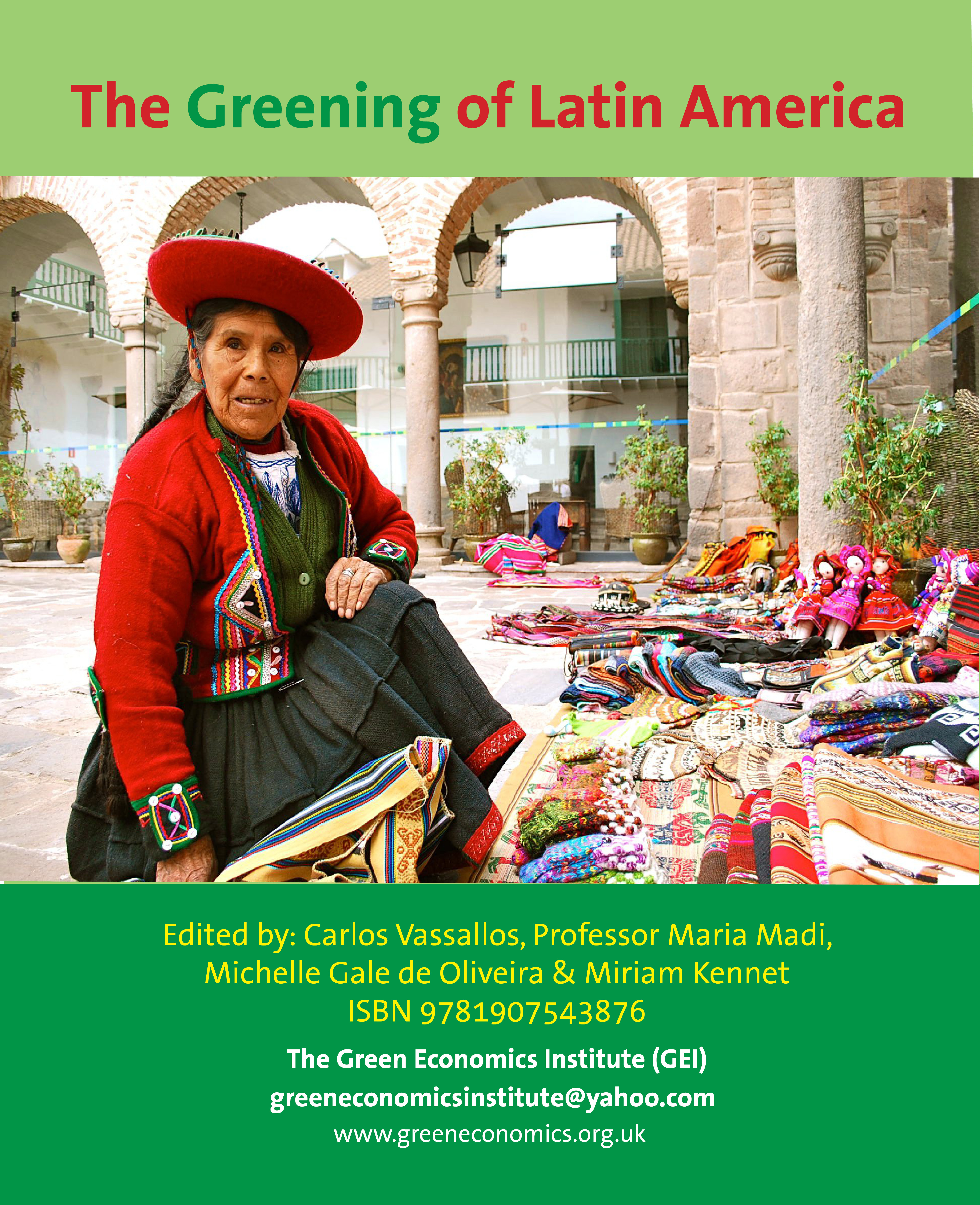
The area has a number of specific challenges- Brazil was one of the fastest growing economies in the world and also home to some of the worlds most important rainforests and biodiversity and housing the worlds largest potential guard against greenhouse gasses and climate change.
It was host to the 2012 Rio + 20 green economics and sustainable development conference.It also has several island states which are extremely vulnerable to climate change and sea level rise.
Its dynamism in todays world economy is charted and analysed and its editors are a mix of experienced professionals -professors, and also young innovative views from around the region – with papers and authors from and about 15 of the countries in this exciting and important and influential region. However the roots of the current crises are discussed and suggestions for the future which green literature and policies can offer provide hope for a new beginning for the region.
Ordering your books
All these books are in stock and can be ordered directly from The Green Economics Institute
greeneconomicsinstitute@yahoo.com
You can pay using Credit or debit cards and Paypal or Bank transfer. Please email and we will send you an invoice or just pay via paypal.
greeneconomicsinstitute@yahoo.com